background image

1

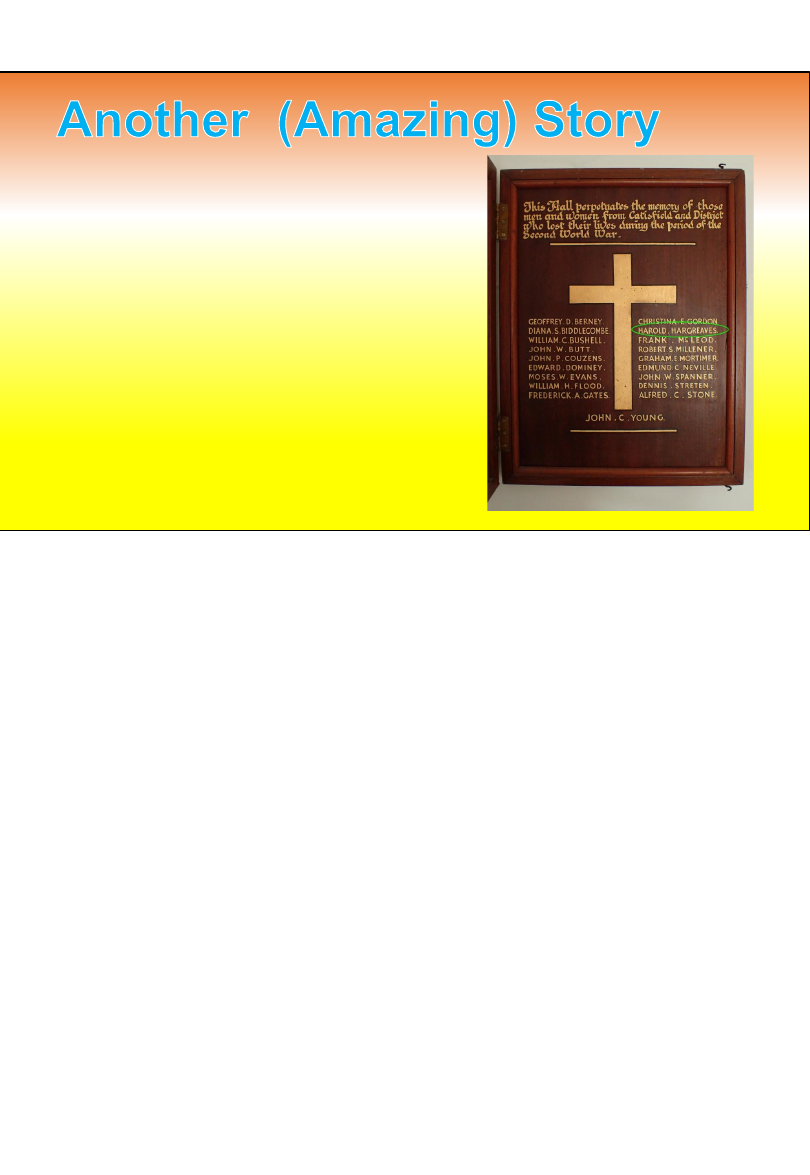
From the Plaque at the 

entrance to  Catisfield

Memorial Hall.

The Story of:

Mr. Harold Hargreaves

From the researches of Doug Glading 

Final4       Last update    20/2/2026

NOTES / Additional Info

Many thanks to Steve Pryde of the 

Operation Chariot Memorial Project

and Peter Lush of the St. Nazaire Society for their advice

1


background image

One of the most dramatic attacks of WW2.

And at the very, very front.

From Catisfield.

Mr Harold Hargreaves, RN

2

You may have heard of ‘Operation Chariot’ – and forgotten the details.

Or it may be new to you.       

It’s a story well worth finding out about 

2


background image

• . 

-

Acting Gunner Mr Harold Hargreaves 

was the man firing the ship’s (12-

pounder) gun, with two loaders 

assisting.

- And he knew he was directly above 

hidden 4 tons of high-explosive.

Operation Chariot

- And that the (unpredictable) fuses were running.
- As the ship passed through the searchlights and many 

guns of the German defences.

3

Described as a  “

Son et lumière from Hell

Notes

3


background image

Operation Chariot

4

Many Books

Many Articles;  Many Reports; 

Films  (fictionalised)

Documentaries  (including a very good BBC one 
called ‘The Greatest Raid of All’)

I don't watch anything containing Jeremy Clarkson these days- he's a real burke.

But he used to be a good journalist.    Have managed to locate a location for the documentary he 
did (it's vanished from the BBC
sites).

Very well done.   No ego bits atall - just the story.  

https://www.youtube.com/watch?v=07Zd0Oy8JyQ 

4


background image

Operation Chariot

- The huge German Battleship Tirpitz was 
lurking in a Norwegian Fjord.
- It would have been a major threat if it was 
allowed to move to the Western Atlantic.

5

- But it could only  operate there  if there 
were servicing  capabilities
- And only St Nazaire had a dock big 
enough…. So had to be put out of 
operation

Picture shows the liner Normandie    in the dry dock which was built for it.

5


background image

Operation Chariot

St Nazaire lies 6 miles up the shallow 
Loire Estuary.

With one dredged channel for shipping.

6

Additionally, there were approximately 700 guns of various calibre, both fixed 
and mobile, including anti-aircraft guns, which could also be used against naval 
targets.

Protected by: Around large 28 guns, 
ranging from 75mm to 280mm, were 
positioned to defend the port against 
naval attacks. 

About 1,000 German  troops manned these defences, plus 
many more in and around the town.

6


background image

Operation Chariot

7

The main target was the dry dock. The 
docks included the  dry-dock - 350 
meters long by 50 meters wide and 16 
m deep. With giant caissons (sliding 
‘gates’) 9 m wide - too big for aircraft 
bombs.
There were three entrances to the 
inner docks.  
Two could be attacked and the third 
could be hampered by attacking the 
gates and  bridges there. 

St Nazaire also housed Submarine Pens – also too substantial to bomb or attack.

Use pointer

This was all before ‘precision bombing’ was introduced

7


background image

Operation Chariot

Initial Idea:  Use 2 Destroyers to 
creep over estuary shallows in 
surprise attack. One Destroyer to 
hit dock gate and land 
commandos, other to collect crew 
and commandos after raid.

BUT:  Only one Destroyer could be 
made available. Also a  second,rescue, 
Destroyer would have to wait for 2 
hours - a big target for defences

Revised Plan:  One Destroyer to 
hit the seaward caisson (and 
land some commandos), rest of 
commandos to go in small fleet 
of Motor Launches.  
On a moonlit night. At high tide.

8

Ship to have 4 tons of 
high-explosive, very 
well concealed.

Fused by 2.5 hour 
pencil charges, and a 
backup fuse system

The ostensible reason was to deny the Tirpitz. But there was an underlying motive  - do a high-profile 
exciting success to raise public morale – and show the USA (and the Germans) that Britain still had fight left. 

Lord Louis Mountbatten, chief of combined operations and responsible for raiding,  approved the idea of 
launching a spectacular attack on the enemy’s heavily-defended shore.    

Luckily the whole project caught the attention of Winston Churchill.  Which helped it get through much 
scepticism.

8


background image

Operation Chariot

Attack: By 264 commandos (166 from No2 Commandos, 
plus specialist commandos originally in  other units eg
RA/RE demolition experts)

In 18 teams of commandos, in three groups.

Priority group aboard the Destroyer, to attack the dry 
facilities such as pumps, winding gear etc.  

Second on the Port flotilla of ML’s, to destroy the ‘Old 

Entrance’ and swing bridge

Third on other flotilla, to attack the ‘South Entrance’ and 

to hold ‘The Mole’ for departure

Just 2 hours ashore

Carefully planned about where each team would land and  what each team would do.

Royal Artillery / Royal Engineers.

The teams each mainly comprised the demolition specialists with one heavily armed 
guardian 

9


background image

Operation Chariot

10

Find a (unwanted) Ship.  The ex American 
‘Buchanan’ became HMS Campbeltown.

Convert it – make it look like German ‘Moewe’ class, 
eg by removing 2 smokestacks.  

Make as light as possible – eg remove main 
armaments and leave just one 12-pounder gun.

But add 2-foot high Quarter-inch armour plate 
vertically  steel barrier on deck to protect 
commandos there. Who lay on their backs.

Train commandos. the King George the fifth 
dock at Southampton was built based on the St  
Nazaire one so the Commandos could study the 
gates and practice 

Shows how exposed Harold’s gun was.

Aim was a draught of 11 feet.

You can see the vertical deck barriers.   And the attempt to protect the bridge.    The 
conversion was done very quickly – in 12 days.

The Campbeltown was also fitted with eight 20mm 
Oerlikons.

10


background image

The Operation had to use ML Motor Launches.  These were the   FairMile
type B of 112 feet long by 18 feet wide, 65 tons,  and normally had a crew of 
16 or so total . Cheap to build, with no armour.    

They used high octane petrol and needed extra tanks, on the deck,  for 

sufficient range to get there, and back .           “Like riding astride a firework”.         
Most of the motor launches would carry 15 commandos..    

Operation Chariot

11

Four of the  motor launches had two torpedo tubes each this 
included ML177 

MTB 74 had to be towed by Campbeltown as it was impossible 
to sail at the slower 15 knots speed of the task force MTP74 
had special adaptation of torpedo tubes – they mounted far 
forward so could go over antitorpedo nets.

MGB314 (also towed) was used as the command centre, 
instead of Campbeltown, in case the ship grounded.

T

he motor launches (600 mile range – 900 mile return trip) had added fuel tanks on Deck with high octane 

fuel. The plan was that they would refill these tanks with seawater before the last stages  - most did this…….

The launches were very  prone to rolling - so the commandos (many had never been to sea) suffered badly 
from sea-sickness.

They were just constructed of wood - two layers of mahogany and one of calico in between. no armour atall
to protect crew and commandos.   Totally unsuited really.

One ML had been on loan to the Free French, so was flying the French flag but crewed by RN.

11


background image

Operation Chariot

12

• Air photo reconnaissance (which enabled the model of the 

docks for planning)

• Sweeps to check seas clear  and to force subs to stay 

submerged. 1 plane lost.

• Five RAF squadrons used for the diversionary bombing raid 

just  before raid. 4 planes lost.

• But Churchill instructed planes only to bomb if target visible 

– but weather clouded over. So many returned without 
dropping.

• Afterwards various planes searched seas for returning boats 

to shepherd them back. One plane lost as it shot down 
Junkers

.

Some 544 aircrew would fly in the 
various elements of RAF support. 
These included men from 
Australian, New Zealand and Polish 
squadrons.

• Spitfires
• Whitleys and
• Wellington bombers

Sunderlands

Lysanders

Blenheims, 

Beaufighters

Hudsons

They had flown 108 sorties 
totalling 675 flying hours.

• In all 9 RAF personnel died

There had been major planning and communication problems 

Bomber Command would not provide bomber numbers requested (as they prioritised 
raids on Germany.)  And were short of aircraft

RAF not informed of all planning decisions

Churchill was anxious to avoid French civilian casualties  so ordered:
Not to fly below 6,000 feet
Only to drop one bomb at a time
Only to bomb if target visible
Not to bomb the town.

12


background image

Operation Chariot

13

At 2 p.m. on the afternoon of March 26, the little armada 
set sail, pretending (for security)  to be an anti-sub patrol. 
With full supplies for full mission, crew included cooks, 
stewards, even a NAAFI man.

It comprised about 355 naval officers and ratings – 76 
crewing the Cambeltown. 

There were also medics, two French officers to liaise with 
locals, Intelligence (including a German civilian working for 
MI9!) and even two journalists. 

They crept over the 
shallows (Cambeltown
grounding twice).

The backup  fuses were 
set. The ship’s concealed 
explosives were set to go off  
between 0500 and 0900 
hours on the morning of 
March 28th

Only when en route were naval personnel told about mission –
and those on Campbeltown learnt it was ‘One Way’.( Once this 

announced the troops apparently decided they might as 
well consume whatever food supplies they wanted….)

On Cambeltown, there were about 78 commandos.   About 50 travelled below decks,  but about 
30   went into the action lying on the deck, on their backs, so as to be ashore as quickly as 
possible.   With explosives on their backs…..

The force totalled 611, ominously replicating the 600 men who rode “Into the jaws of death, into 
the mouth of hell” in Tennyson’s celebrated description of The Charge of the Light Brigade.

13


background image

01:27: The German flags were then 
replaced with White Ensigns when the fleet 
was 6 minutes from its target.

The Germans responded with intense 

shelling and gun fire during the final 15 
minutes of the run in, during which half the 
men aboard the MLs were either killed or 
wounded.

A survivor said 

“It was as if every gun in 

world was firing at us”

Operation Chariot

14

The cloud cover went to 10/10, limiting the RAF bombing distraction.

There were challenges from the defences, but the force responded with correct German codes

By 2200 that night the force sighted a light from the Royal Navy submarine Sturgeon, posted as a navigational 
beacon to mark the starting point for the final leg into the mouth of the Loire

Last two miles indicated by elipse

It was a rule of war that false flags were 

lowered before opening fire and this is what happened. It is 
generally accepted that this happened with ONE mile (six 
minutes sailing) to go (see Jim Dorrian pp 126-128)

6 launches attempted to come alongside the fortified Old Mole, only one and the MGB put men ashore. 
At the second landing site in the Old Entrance, only two troop-carrying MLs managed to disembark their men. 

Only at the dry dock was success achieved in full with Campbeltown, by dint of her steel hull and her officers' 

14


background image

skill, landing her Commandos. 
(NB  some were already injured by then)

14


background image

Operation Chariot

15

Mr Hargreaves and his loaders started 
firing the 12-pounder at the searchlights 
and defences.   ( As she is the most 
prominent ship, fully illuminated by powerful 
searchlights, HMS Campbeltown is 
repeatedly hit. The helmsman and his 
replacement are killed. )

Walter Rainbird, a  19 year old cook, 
loaded the shells and an Officers’ Steward 
loaded the cordite charge 

At 500 yards out Mr Hargreaves team are 
told to go below

.

The people manning the gun included Walter Rainbird, a  19 year old cook, who loaded the shells and an 
Officers Stewart who loaded the cordite charge . 

We think the steward may have been  

Petty Officer Steward Albert Edward 

LOVE

.   He lived at North Boarhunt.  He was killed in action.                                                            

15


background image

Operation Chariot

16

At 01:34 hours speeding up to  20kts, 
Campbeltown strikes the 'Normandie' dock 
caisson dead-centre, her velocity carrying her 
over and across its nine metre width - exactly as 
planned
. But 4 minutes late!
The photos show  the damage sustained during 
the approach  – yet the explosives were not 
triggered

.

Those commandos able to move,  poured off, 
and set about sabotaging the dock pumps, 
gate winding gear etc

.

Mr Hargreaves set about his next task – activating the scuttling 
charges to flood the stern, so the ship could not be towed off. 

He then helped the doctor with the wounded crew and commandos

A number of commandos on the Campbeltown  were killed or injured during the 
approach.                         As were some crew.

In the four minutes around the ramming by the Campbeltown eight of the launches were 
destroyed in the channel. 
Most of the eight craft destroyed suffered greater than 80% fatalities.

So many of the secondary missions did not happen.

The main fusing of the hidden explosives were said to be 2.5-hour timers, triggered by a 
secret switch on the PO’s wardroom.  The wardroom was hit by a shell during the run-in –
without triggering the bomb. You can see the shellhole below the gun.

16


background image

Operation Chariot used unsuitable ships - wooden Motor Launches and an antiquated 
ex-American World War One destroyer now in British Service - with inadequate 
weapons, short of ammunition, denied effective gun or air support, and yet 
determined absolutely to sacrifice themselves to save their Merchant Navy comrades 
from destruction by Tirpitz' s massive guns.

16


background image

ML177 went to the stern.  

Mr Hargreaves helped the ships doctor

,  

Surgeon Lt W. James (“Jock”) Winthrope RCNVR,

to load about 30 more 

navy and commando personnel

Operation Chariot

17

The HQ Ship MGB 314 took on  about   30   wounded crew and commandos 
from Cambeltown. It was heavily damaged off St Nazaire and was scuttled to 
prevent capture.

MTB 74 fired her torpedoes against the foundations of the ‘old entrance’ dock 

gate. They were delayed action and exploded …. 

She had 10 crew and picked up 26 men off Cambeltown, but stopped to pick up 

two more, but was hit. Only 3 of the 36 who took to a raft  survived.

Summary of Small Boats

Sunk: MTB314, ML298, 
ML447, ML 457, ML192, 
ML262, ML267, ML268, 
ML177, 

Scuttled: after transferring 
to rescue ships :ML156*, 
ML446*, ML 270*

Captured:  ML306

Returned:

ML307 & 443 failed to 

land commandos. 

ML341 engine trouble, 
returned.  

ML160 rescued crew of 
ML447 and returned.

Ml177 overloaded, so fired off its torpedoes to lessen weight, and set off 
at 20 knots down the estuary for the open sea.
However about 3 miles out  ML177  engines were hit and she stopped, a 
searchlight got them, they had no steering and then they caught fire and 
sank. Two people are thought to have survived.

There is no record of how Mr Hargreaves and the doctor died -
whether it was from gunshot or the waters 

.

Notes

17


background image

Operation Chariot

18

Come the morning  Cambeltown was firmly stuck on top of the dock gate.   (Some of he 
captured Brits were marched past it – without giving away that there was a huge explosive 
charge hidden in the destroyer’s bow).

Just before noon local time a party of around 40 German officers was 
being shown around the ship. And many sightseers were lining the dock.

Then it blew – the huge explosion killed or wounded an estimated 360 Germans and locals --
Bits of dead found 400 yds away on roof of the sub pens….

And the dock gate was blown in, putting the dock out of action for the rest of the war. And 
the winding gear and pumps had been destroyed by the commandos.

So main objective attained.

18


background image

• At least 11 of the commandos     on 

Campbeltown died.

• At 02:30 the CO of the Naval force 

decided no option but to withdraw. Half 
the commando force found themselves 
stranded,  many wounded..

There were no launches to take them. 

They were ordered to break up into 

small groups and try to make it to the  

Spanish border  - 5 did.

19

Operation Chariot

Took Part

Killed/MIA

Captured

Returned

Army

264

66

124

69

Numbers:

.

So  72% of the commandos were either killed or captured.

19


background image

• Remember:  Most of the crew of HMS 

Campbeltown did not know they 
were going on a ‘One-Way’ mission.

Took Part

Killed/MIA

Captured

Returned

Army

264

66

124

69

RN

355

103

90

162

20

Operation Chariot

The Navy: 

Notes:

20


background image

Out of a total of 625 individuals 
involved  (Navy and Army) on 
the sea operation  169 men 
died 
- mainly in the burning 
waters of the estuary.

101 of them having no known 

grave.

Took Part

Killed/MIA

Captured

Returned

Army

355

103

90

162

RN

355

103

90

162

Total Sea 

Force

625

169

217

234

RAF

544

9

3

21

Operation Chariot

BUT: The main objective attained.

There were also 6 ‘others’, 3 of these were captured, 3 returned

Some secondary objectives, such as destroying the caisson power and hydraulics, were achieved. 

21


background image

Operation Chariot

22

.

Most of the dead are buried at Escoublac

The main surviving part of the 
ship (displayed at St Nazaire)
A door from below the bridge 
of Campbeltown has been 
dredged up recently 

Notes: 

22


background image

Operation Chariot

23

A new 

iconic and enduring memorial at the National Memorial 

Arboretum in Staffordshire was constructed 2026.

.

The sculpture is  

a steel replica of HMS Campbeltown riding high on the caisson gate 

will and includes 5 bronze 

commando figures, 180 mm tall to provide a sense of scale.

The

formal dedication of 

the completed monument 
planned on the 85th 

anniversary of the raid in 

May 2027

23


background image

Operation Chariot

24

5 Victoria Crosses

4 Distinguished Service Order;

17 Distinguished Service Cross;

11 Military Cross;

4 Conspicuous Gallantry Medal;

5 Distinguished Conduct Medal; 

24 Distinguished Service Medal and 

15 Military Medal. 

Another 51 men were mentioned in 
dispatches, 22 of them posthumously.

Plus 4 Croix de Guerres

.

Also amongst those ‘ Mentioned in Despatches’ was the NAAFi man James Bourne

140 decorations awarded in all

24


background image

Operation Chariot

25

Born Barnsley     5 may 1903.   Son of a  Master Brickmaker, so started life as one. 

Joined Navy,  as boy,  in May  1919   (s/n J95238)

Became Regular  as Ord Seaman  2 Mar 1921 for 12 years

Acting Leading Seaman 10 July 32    

Leading Seaman  10 Jul 33

Acting Petty Officer 11 Apl 35 

PO 22 Aug 36  

CPO 7 Oct 40  

10 Oct 1941 T Acting Gunner      (Warrant Officer, so became “Mr.”)

Notes:

25


background image

Operation Chariot

26

Served in various ships, including HMS  Hood from  10 
Mar 1931 to 31 Aug 33 (when it based Portsmouth)

Married Helena Adelaide Hargreaves 

( nee Gardiner) of Southsea.   

Wedding was in Portsmouth  July 1931

They lived at 37 Highlands Road, Catisfield

(dates 

uncertain)

Helena remarried Oct 1946 to Edwin Hayes and died 
1978 at 170 Highlands Rd

26


background image

Operation Chariot

27

Harold’s body  was 
recovered and was buried at 
Le Clion-Sur-Mer 
Communal Cemetery.

(A different location to 
most of the Operation 
Chariot dead.)

27


background image

Thank You.

Please remember proudly 

these people  from 

Catisfield who gave their 

Tomorrows.

Any Comments, or if you can add new 
information, please contact       

history@catisfield.com

• Supply  Assistant Geoffrey David Berney RNVR
• Wren Driver Diana Sydney Biddlecombe RN
• Commander William Charles Bushell DSC  RN
• Flying Officer John Weldon Butt    RAFVR
• Lieutenant John Philip Couzens, Royal Artillery
• Lance Bombardier Edward Lionel Dominey,  Royal Artillery 
• Warrant Mechanician Moses William Evans, RN. 
• Leading Aircraftsman William Henry Flood.   RAFVR
• WO Class I Frederick  Augustus Gates RSM, Royal Artillery
• Christina Emsie Gordon
• Temp Acting Gunner (T) Mr Harold  Hargreaves  WO RN
• Lieutenant (E) Frank McLeod RN,
• Petty Officer Robert Savitri Millener, RN
• Lieutenant Edward Graham Mortimer RNVR
• Private Edmund Charles Neville, Infantry
• Able Seaman John Woodman Spanner,  RN
• Mr Alfred Dennis Streten
• Captain Charles Edward Stone Royal Artillery
• Clement (John) Young Merchant Navy

28

28